
Lucky Vegas Registration and Verification for UK Players
 Available in GB
Lucky Vegas registration for a Great Britain player is not an anonymous sign-up followed by checks only when money is withdrawn. UK Gambling Commission rules require remote operators to verify, as a minimum, a customer’s name, address and date of birth before allowing them to gamble. Lucky Vegas also publishes a current GB verification guide explaining the document categories it can request: proof of identity, proof of address and evidence for a payment method used on the account. Its guide currently says document checks are usually completed in less than 12 hours and advises contacting support if there has been no response within 48 hours. Those figures describe the document-review stage, not a guaranteed registration or withdrawal time. The practical approach is to register through the verified luckyvegas.com domain, enter accurate personal details, complete required checks early, set or review a financial limit before the first deposit, and keep the account name and payment ownership consistent.
Lucky Vegas sign-up: the practical order
- Start from the verified domain. Use the verified luckyvegas.com domain. Check the domain before entering personal or payment information, especially if you reached the brand through search results, an advert or an old bookmark.
- Provide accurate account details. Great Britain identity rules make correct name, address and date of birth information central to account creation. Do not treat these fields as disposable profile data: they are part of the identity record the operator must verify.
- Complete identity verification before gambling. The UKGC requirement is pre-gambling verification. Electronic checks can sometimes establish the necessary information without a manual upload, but the operator can request supporting documents when needed.
- Deal with the financial-limit prompt before the first deposit. Current Remote Gambling and Software Technical Standards require customers to be prompted to set a financial limit before they make their first deposit. The system must also make limit tools accessible from registration onwards.
- Choose a payment route that belongs to you and keep records consistent. Lucky Vegas’s own verification guidance includes payment-method evidence, so a funding method is not separate from KYC. The broader cashier choices are covered in the deposit and payment methods guide.
- Upload requested documents clearly. Follow the current brand instructions rather than using a generic casino-document checklist. The accepted examples and formatting rules are specific enough to matter.
This sequence is more useful than a promise of “instant registration” because it separates the visible sign-up form from the regulated checks that make an account usable. The exact on-screen order can change, but the identity and limit-setting obligations remain the important decision points.
What Lucky Vegas currently asks for during verification
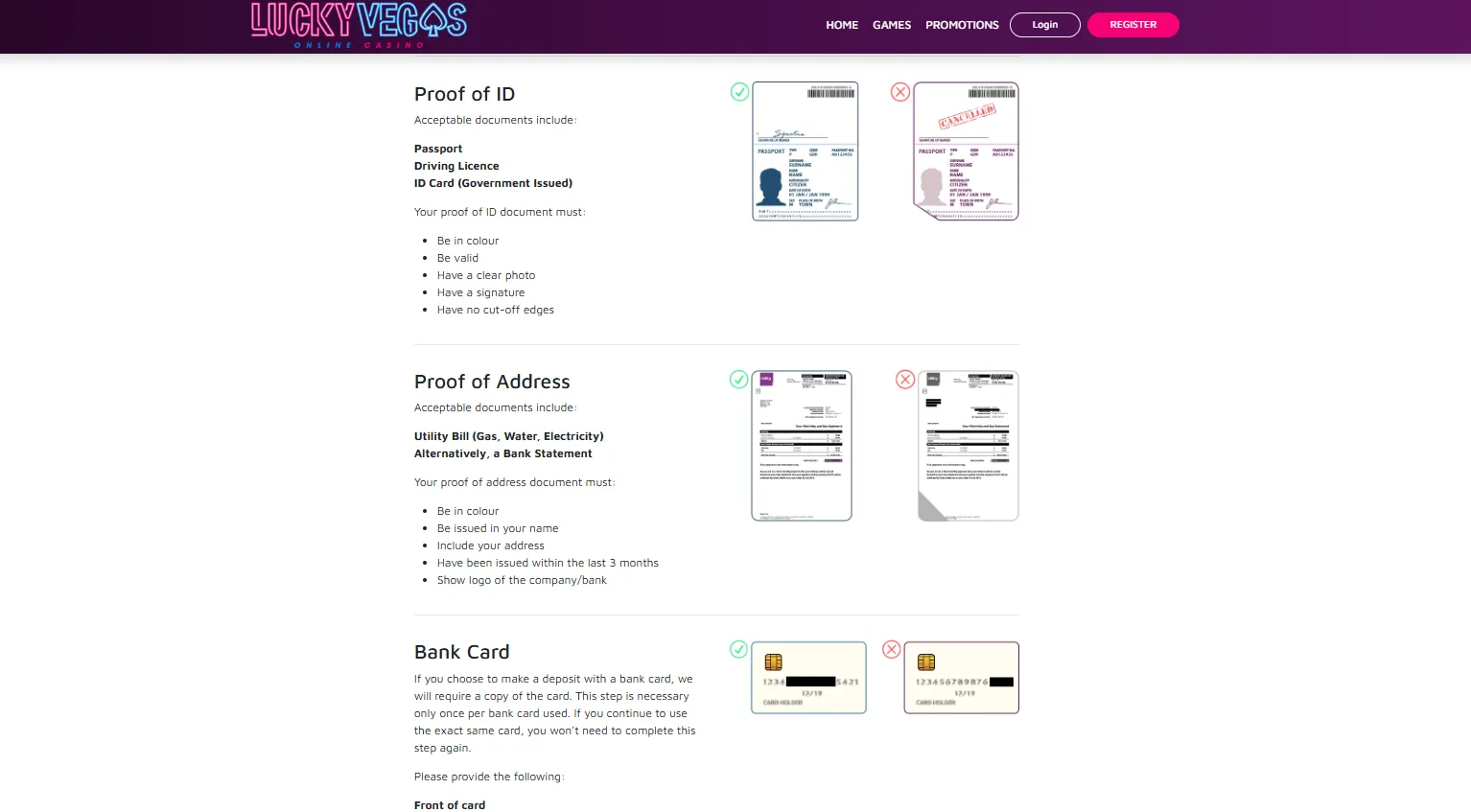
The official Lucky Vegas GB uploading-documents page says customers can be required to verify identity, address and the payment method used. For proof of identity, its current examples are a passport, driving licence or government-issued ID card. The page says an ID document should be in colour, valid, show a clear photo and signature, and have no cut-off edges.
For proof of address, Lucky Vegas lists a utility bill for gas, water or electricity, or alternatively a bank statement. Its current requirements say the document should be in colour, issued in the customer’s name, show the registered address, show the company or bank logo and have been issued within the last three months.
If a bank card has been used, the guide also describes card evidence. It currently instructs customers to leave only the first four and last four digits visible and to cover the eight middle digits. The page says the card step is required once per card used, while extra uploads can be requested after a new bank card, a new payment method or a change in personal information such as name or address.
These details are set out in the current Lucky Vegas GB verification guide. They are deliberately not expanded with unsourced items such as a council-tax bill, payslip or source-of-funds document list. Other checks can become necessary under legal or account-specific circumstances, but this page only presents the operator-specific document examples supported by the current official guide.
How long does Lucky Vegas verification take?
Lucky Vegas currently says it checks uploaded documents as quickly as possible and that the process is usually less than 12 hours. It also says extra verification can make the process take longer and advises customers to contact support if they have not heard back within 48 hours.
Read that timing narrowly. It is the operator’s current guidance for reviewing uploaded documents, not a guaranteed deadline for opening an account, activating a bonus or receiving a withdrawal. Registration may involve electronic identity checking before a manual document upload is required, while a withdrawal has its own processing and payment-rail stages. If a cashout is already the issue, use the dedicated withdrawal guide rather than adding the 12-hour KYC guidance to an assumed payout time.
The strongest way to reduce avoidable back-and-forth is procedural: submit clear uncropped files, make sure the name and address agree with the account, use the requested document category, and respond to any specific follow-up request rather than uploading unrelated files.
What UKGC identity rules change about the sign-up process
The Gambling Commission’s identity-verification guidance states that remote operators must verify at least the customer’s name, address and date of birth before allowing gambling. It also says customers should be told before depositing what types of identity documents or other information might be required, in what circumstances and how that information should be supplied.
There is also an important withdrawal protection. A withdrawal request must not itself result in a demand for additional information if the operator could reasonably have expected to request that information earlier. This does not remove later checks that become necessary for another legal reason, but it is why basic identity verification should not be understood as a hurdle invented only after a win.
For the site’s operator and current regulator record, see the UKGC rules and licence page. That page also explains the territorial distinction: UKGC remote-gambling regulation is the Great Britain framework for England, Scotland and Wales, while Northern Ireland has a separate legal regime.
The financial-limit prompt before the first deposit
Registration now connects directly to a safer-gambling control that is easy to miss in older casino guides. Since 31 October 2025, Great Britain remote gambling systems have had to prompt customers to set a financial limit before the first deposit, while allowing limit-setting facilities from the point of registration. Current rules also require account-level limit tools and a free-text input or equivalent so the customer can choose a meaningful amount.
As of 27 August 2026, a second terminology change has not yet taken effect. The Gambling Commission extended the next phase to 30 September 2026. From that date, operators must offer a gross deposit limit and only that gross-deposit form may be labelled a “deposit limit”. Until then, the useful current point for a new Lucky Vegas account is simpler: expect a financial-limit prompt before making the first deposit and use it as a budget control rather than treating it as a registration obstacle.
The Commission’s current financial-limit position is set out in its implementation update and the applicable Remote Gambling and Software Technical Standards.
How registration connects to the current welcome offer
The current Lucky Vegas GB homepage advertises a first-deposit welcome offer and states a £10 minimum first deposit. That does not replace identity verification, and a promotional deposit should not be treated as a way to skip the normal account checks. Registration establishes the account, KYC establishes who is using it, and the promotion has its own eligibility and wagering terms.
If the offer is part of the reason you are creating the account, read the current welcome offer guide before depositing. That page owns the detailed free-spins, wagering and maximum-bet terms, so this registration page does not duplicate them. The useful registration-specific point is to have the identity record and payment ownership in good order before adding a qualifying deposit.
Payment ownership and withdrawal readiness
Lucky Vegas’s document guide makes payment ownership part of the verification picture. That matters because a clean registration is not only about getting through the first session. It also reduces ambiguity later when the account requests a withdrawal. A new card, a new payment method or changed personal information can trigger additional document uploads under the current brand guidance.
Keep a simple chain of consistency: the account belongs to you, the identity evidence matches the account, the registered address matches the proof supplied, and the payment method can be evidenced where the operator requests it. That does not guarantee a particular withdrawal speed, but it avoids the common category of delay caused by mismatched or incomplete account evidence.
Login and account-access safety
A separate thin “Lucky Vegas login” page would add little value, so the navigational guidance belongs here. Use luckyvegas.com as the domain check and navigate to the login or register control from the official site. Do not enter credentials into a lookalike domain simply because the page uses a familiar casino name or logo.
If access fails, distinguish a credential problem from verification status. A password or account-access issue is not the same thing as a request for identity documents, and a KYC upload request is not proof that a withdrawal has failed. Keeping those categories separate makes support conversations more precise and reduces the temptation to submit unnecessary documents.
Registration mistakes that create avoidable friction
| Mistake | Why it matters | Better approach |
|---|---|---|
| Using shortened or inconsistent personal details | The operator must establish identity and may need evidence matching the account | Enter accurate legal identity and address information from the start |
| Uploading cropped or unclear ID | Lucky Vegas’s guide requires clear, valid documents with no cut-off edges | Follow the current image-quality requirements |
| Using an address document older than the stated window | The current Lucky Vegas guide specifies an issue date within the last three months | Use a current qualifying utility bill or bank statement |
| Assuming card evidence should show the full card number | The official guide says the middle eight digits should be covered | Follow the brand’s masking instructions exactly |
| Waiting for a withdrawal before reading KYC guidance | Identity verification is part of regulated account operation, not a cashout-only event | Complete requested checks early and keep details current |
| Treating the first deposit as the whole sign-up process | Financial-limit prompting and promotional rules are separate account steps | Review limits, payment ownership and bonus terms before funding |
Lucky Vegas registration FAQ
Can I play at Lucky Vegas without KYC?
Not as a Great Britain regulated-account model. UKGC rules require remote operators to verify at least name, address and date of birth before allowing a customer to gamble. Lucky Vegas also publishes document guidance for identity, address and payment-method checks.
Which ID documents does Lucky Vegas list?
The current GB verification guide lists a passport, driving licence and government-issued ID card as proof-of-identity examples. Use the live guide when submitting documents because exact requirements are operational details that can change.
What can I use as proof of address?
Lucky Vegas currently lists a gas, water or electricity utility bill, or a bank statement. The document should be in your name, include your address and have been issued within the last three months, along with the other presentation requirements on the official guide.
Does Lucky Vegas guarantee verification within 12 hours?
No. The current wording says document checks are usually completed in less than 12 hours and can take longer when extra verification is needed. The operator advises contacting support after 48 hours without a response.
Do I need to set a deposit limit during registration?
The current Great Britain rule requires a financial-limit prompt before the first deposit and makes limit facilities available from registration. A further rule defining gross deposit limits as the only limits that may be called “deposit limits” is due to take effect on 30 September 2026.
Bottom line
Lucky Vegas registration is best treated as an end-to-end account setup rather than a short form followed by gambling. Verify the official domain, provide accurate details, complete the pre-gambling identity checks, respond to any operator-specific document request, use the financial-limit prompt before the first deposit and keep payment ownership consistent. The current official guide gives unusually concrete document examples and a current review-time guide, while UKGC rules explain why identity checking belongs before gambling rather than being saved for withdrawal. Once those pieces are in place, use the site’s full UK review for the wider product picture and the specialist pages for bonus, payment, withdrawal and licence details.
Lucky Vegas Payment Methods for UK Players
Content created by the «Lucky Vegas» team